
Fountain Control Systems: DMX512 vs PLC for Water Shows
- Conocimiento del Producto
- Zhongyao Cao
Introduction
Behind every captivating fountain performance lies an invisible conductor: the control system. It orchestrates pumps, valves, and lights with precision timing, transforming water into a living art form. But for engineers and project owners, selecting the right control architecture is a critical decision that affects cost, flexibility, and long-term reliability.
Two technologies dominate the fountain industry: DMX512 and PLC. Understanding their strengths and limitations will help you specify the ideal system for your project.
1. What is a Fountain Control System?
At its core, a fountain control system manages two types of devices: those that move water (pumps, valves, nozzles) and those that illuminate it (lights, lasers). The system receives input from a show programmer—either pre-recorded sequences or real-time commands—and translates that into precise electrical signals.
Modern systems also handle safety interlocks, water treatment coordination, and remote monitoring. The choice of control platform determines how easily these functions can be integrated and how the fountain will evolve over time.
2. DMX512: The Standard for Theatrical Control
DMX512 was originally developed for stage lighting, but its real-time, multi-channel capabilities make it ideal for fountain choreography.
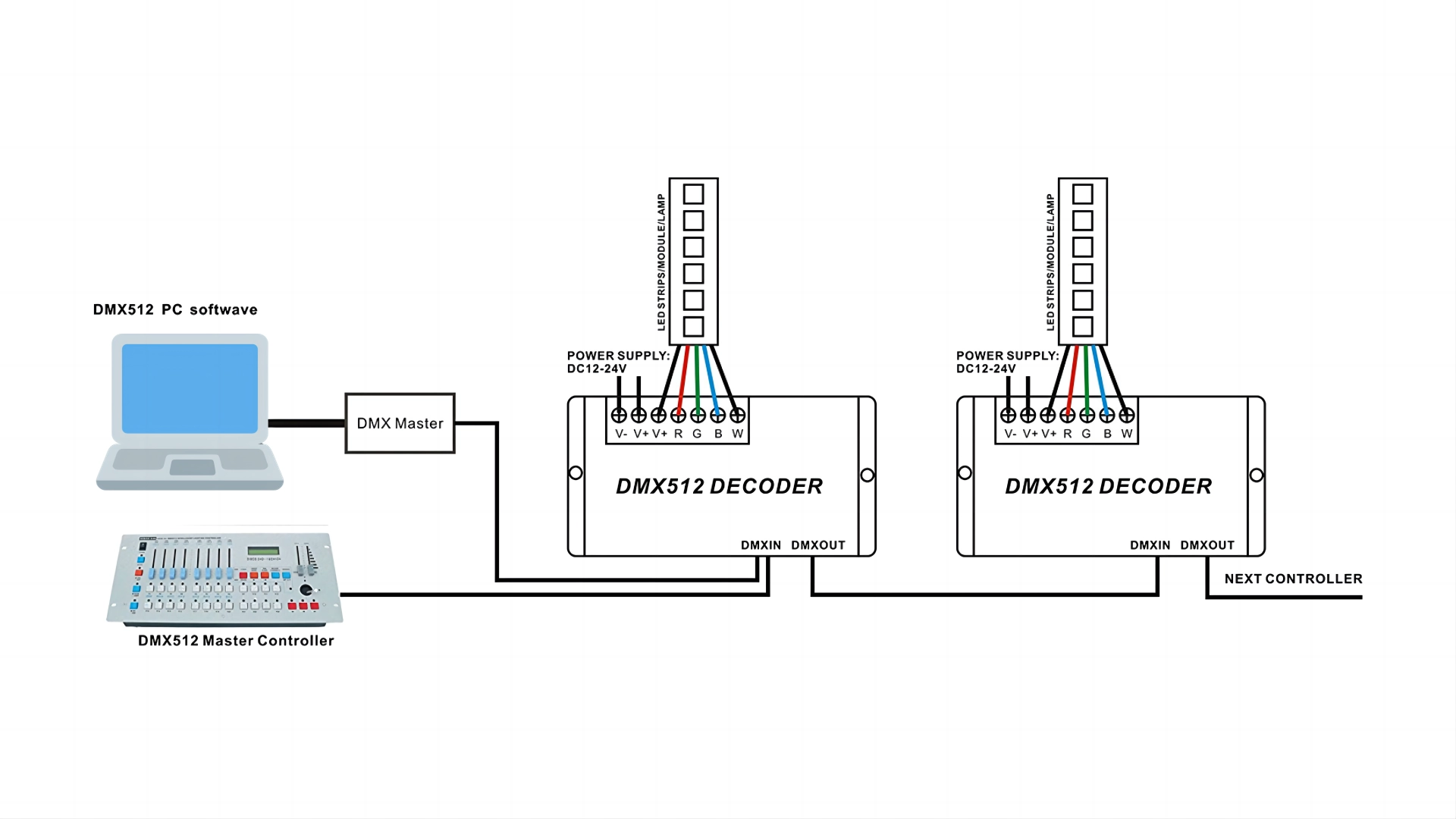
How It Works: DMX sends digital signals over a daisy-chained network. Each device (a light fixture or a valve) occupies a range of addresses, receiving 512 possible channels of data updated up to 44 times per second. This speed enables seamless synchronization of water and light.
Strengths: Unmatched for shows with complex, rapidly changing effects. It is the industry standard for RGB lighting and moving nozzles. DMX controllers are relatively inexpensive and widely supported by show design software.
Limitations: DMX is a unidirectional protocol—it sends commands but does not receive feedback. If a device fails, the controller does not know. It also requires careful termination and signal boosting over long distances.
3. PLC: The Workhorse of Industrial Automation
Programmable Logic Controllers (PLCs) are rugged industrial computers designed for reliability and safety in harsh environments.
How It Works: PLCs run ladder logic programs that monitor inputs (sensors, limit switches) and control outputs (pumps, valves). They operate deterministically, meaning they guarantee a response within a fixed time window—critical for safety functions.
Strengths: PLCs excel at managing the “utility” side of a fountain: filling tanks, maintaining water levels, filtering, and emergency shutdown. They provide two-way communication, allowing operators to monitor status and diagnose faults remotely.
Limitations: PLC programming is less intuitive for artistic show design. While modern PLCs can handle basic timing, complex choreography is difficult to achieve without an external show controller.
4. DMX vs PLC: Not an Either/Or Choice
In practice, large-scale fountain projects rarely rely on a single control type. The most robust systems combine both:
PLC as the Master: The PLC handles all safety interlocks, pump starts, water treatment, and failsafe routines. It ensures the fountain operates within safe parameters at all times.
DMX as the Show Controller: The DMX system receives permission from the PLC to run, then executes the artistic show—controlling lights, fountain choreography, and music synchronization.
Communication Between Them: The two systems exchange signals via hardwired relays or industrial protocols like Modbus. For example, the PLC might send a “Show Start” command to the DMX controller and monitor that all devices are responding correctly.
This hybrid architecture gives you the best of both worlds: the reliability of industrial automation and the creative freedom of DMX.
5. Key Components of a Modern Control System
Beyond the core controllers, several other elements matter:
Amplifiers and Splitters: DMX signals degrade over distance. Amplifiers boost the signal, while opto-splitters isolate sections of the network to prevent a fault in one device from taking down the entire show.
Remote I/O Modules: In large fountains, it is impractical to run all wires back to a central cabinet. Remote input/output modules communicate with the PLC via Ethernet or fiber, reducing installation complexity.
Human-Machine Interface (HMI): A touchscreen panel allows operators to start/stop shows, monitor water levels, and view alarms. For public fountains, this is often located in a secure equipment room.
Time Synchronization: For shows that run on a schedule, the control system must maintain accurate time—often via GPS or NTP—to ensure performances start precisely when advertised.
6. Programming and Show Design
The software used to create fountain performances is as important as the hardware.
Show Authoring Tools: Specialized programs (like ShowCAD, MadMapper, or bespoke solutions) allow designers to sequence water effects, lights, and music on a timeline. The output is typically a DMX stream.
Simulation: Advanced projects use 3D visualization software to preview the show before installation, saving time and reducing on-site adjustments.
Remote Updates: Once installed, the ability to upload new shows via the internet allows the fountain to evolve with seasons, holidays, or special events—adding long-term value.
7. Reliability and Redundancy
For landmark fountains that operate daily, downtime is unacceptable. Control system design should incorporate:
Redundant Power Supplies: Dual power inputs with automatic failover.
Hot-Swappable Modules: The ability to replace a failed I/O card without shutting down the entire system.
Backup Controllers: In critical applications, a standby PLC can take over instantly if the primary fails.
Surge Protection: Fountains are exposed to lightning risks. Comprehensive surge suppression on all incoming lines and signal cables is essential.
Conclusion
Choosing between DMX512 and PLC is not about which is “better”—it is about matching the tool to the task. DMX delivers the artistic flexibility needed for world-class water shows. PLC provides the industrial reliability required for safe, round-the-clock operation. When combined intelligently, they form a control system capable of managing everything from a quiet reflecting pool to a spectacular multimedia performance.
At HUALUO, we engineer integrated control solutions tailored to each project’s scale and complexity. Our team specifies, programs, and commissions systems that ensure your fountain performs flawlessly for decades.
Ready to discuss your project’s control requirements? Contact us for a technical consultation.
Related Posts

Solicite una Propuesta y Estimado
Envíenos fotos/videos de su sitio y los datos básicos para una fuente flotante. Le responderemos con una orientación conceptual de plataforma, una sugerencia de configuración y un estimado de presupuesto.
Información de Contacto
- DIRECCIÓN: No. 399, Calle Antai, Zona de Desarrollo Económico, Ciudad de Neijiang, Provincia de Sichuan, China.
- CORREO ELECTRÓNICO: sales@hualuolighting.com
- WHATSAPP: 0086 19302661002
SÍGANOS:
Sus datos serán destinados exclusivamente a la consultoría del proyecto.