How to Choose a Musical Fountain EPC Contractor? 7 Key Criteria for Large-Scale Projects | HUALUO
- Product Knowledge
- Zhongyao Cao
Introduction
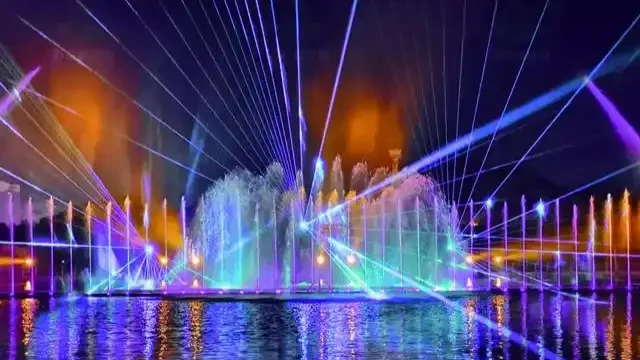
Laser light adds a dimension of brilliance that traditional lighting cannot match. Sharp beams, vibrant colors, and animated graphics projected onto water screens or mist create unforgettable spectacles. But specifying laser systems for outdoor fountain environments requires careful consideration of performance, safety, and durability.
This guide covers everything you need to know to select the right laser equipment for your next water feature project.
1. How Laser Projectors Work
A laser projector generates intense, coherent light beams that are steered by fast-moving mirrors (galvanometers) to draw patterns, text, or animations in the air or on surfaces. Unlike conventional lights, lasers remain focused over long distances, making them ideal for large-scale water shows.
Laser light is measured in milliwatts (mW) or watts (W). Higher power produces brighter, more visible beams, but also increases safety requirements.
2. Types of Laser Projectors
RGB Laser Projectors: Combine red, green, and blue diodes to create millions of colors. These are the most common for fountain shows, allowing full-color graphics and beam effects. White balance and color calibration are important for accurate reproduction.
Animation Laser Projectors: Equipped with faster scanners and advanced control electronics to project complex animated sequences, logos, or text onto water screens or building facades.
Beam/Sky Lasers: Designed to shoot powerful beams into the sky, often used for long-range effects above the fountain. They typically have higher power and narrower beam divergence.
Outdoor/Waterproof Lasers: Enclosed in weatherproof housings (IP65 or higher) with built-in heating/cooling to withstand rain, dust, and temperature extremes. Essential for permanent outdoor installations.
3. Key Selection Criteria
Power (Output): Match power to the desired effect and throw distance. For a water screen 50 meters away, 10W–30W RGB may be needed. For sky beams, 30W+ is common. Indoor or small fountains may use 1W–5W.
Scanner Speed: Measured in kilopoints per second (kpps). Faster scanners (30kpps–60kpps) produce smoother, more complex animations without visible lag.
Beam Divergence: A narrower divergence (e.g., <1 mrad) keeps the beam tight over distance, critical for sky effects. For graphics, a slightly wider divergence may be acceptable.
Color Performance: Look for lasers with well-matched diode wavelengths for true color mixing. Some projectors include additional diodes (yellow, cyan) for expanded gamut.
Control Interface: DMX is standard for color and effect selection, but ILDA (International Laser Display Association) is the protocol for precise beam steering and animation. Ensure the projector supports both or can be integrated via a converter.
4. Outdoor Durability
Permanent outdoor laser installations face harsh conditions: sun, rain, dust, and temperature swings.
IP Rating: Minimum IP65 for protection against water jets and dust. IP66 or IP67 is better for high-pressure washdown or temporary submersion.
Operating Temperature: Look for units with built-in heaters for cold climates and fans or TEC cooling for hot environments. Condensation prevention is vital.
Optical Protection: Some projectors include automatic shutter or power reduction if the housing temperature exceeds safe limits.
5. Safety Classes and Regulations
Lasers are classified by their potential to cause eye injury. Classes are defined by international standards (IEC 60825).
Class 1: Safe under all conditions; no risk.
Class 2, 2M: Low power; blink reflex protects eyes.
Class 3R: Direct viewing potentially hazardous; restricted use.
Class 3B, 4: High power; direct and diffuse reflections can cause eye and skin injury. Require strict safety measures: key switches, emission delays, safety zones, and trained operators.
Most large fountain shows use Class 3B or 4 lasers. To comply with regulations:
Install safety interlocks that disable the laser if the water screen fails or if people approach the beam area.
Conduct a hazard analysis and define a Nominal Ocular Hazard Distance (NOHD).
Work with certified laser safety officers during installation and operation.
6. Integration with Fountain Control
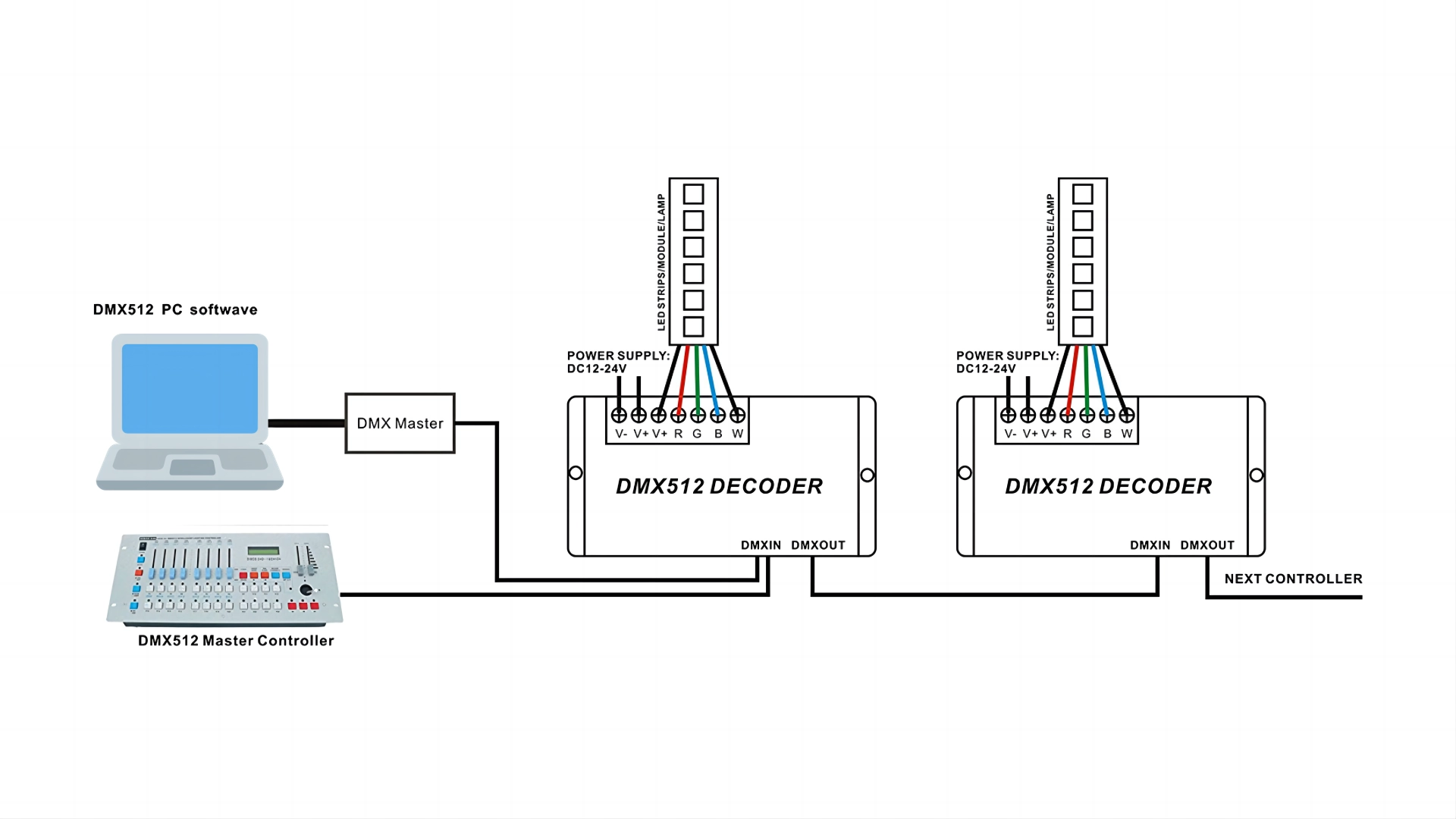
For a synchronized show, lasers must be integrated with the fountain’s DMX or timecode system.
DMX Control: Used for color selection, pattern recall, and master enable/disable. Easy to program alongside lighting cues.
ILDA/Software Control: For custom animations, the laser runs from a media server or dedicated show controller that outputs ILDA signals. The timeline is synced with music and water effects via MIDI timecode or SMPTE.
Hybrid Approach: Many modern projectors accept both DMX for simple cues and ILDA for complex scenes, with seamless switching during the show.
7. Maintenance Considerations
Clean Optics: Outdoor lasers accumulate dust on output windows. Regular cleaning with approved solutions preserves brightness.
Diode Lifespan: Laser diodes degrade over time (typically 10,000+ hours). Plan for eventual replacement or factor in spare units.
Cooling System Checks: Ensure fans and filters are cleaned to prevent overheating failures.
Conclusion
Selecting the right laser system elevates a fountain show from beautiful to unforgettable. By understanding power requirements, safety obligations, and environmental durability, you can specify equipment that delivers stunning visuals reliably for years.
At HUALUO, we supply fully integrated laser solutions—from RGB animation projectors to outdoor-rated beam lasers—all certified to international safety standards. Our team can assist with system design, safety planning, and show programming.
Ready to add laser magic to your fountain? Contact us for a technical consultation.
Related Posts
Get a Proposal & Budget Estimate
Send your site photos/video and basic data. We’ll reply with a platform concept direction, configuration suggestion, and budget estimate.
Contact Info.
- ADDRESS: No. 399, Antai Street, Economic Development Zone, Neijiang City, Sichuan Province, China.
- Email: sales@hualuolighting.com
- WHATSAPP: 0086 19302661002
Follow Us:
Your information is used only for project consultation.