The Ultimate Guide to Fountain Lights: IP Ratings, Beam Angles & LED Selection
- Product Knowledge
- Zhongyao Cao
Introduction
Water and electricity—getting this combination right is the cornerstone of any successful fountain project. The lighting transforms a simple water feature into a mesmerizing spectacle after dark, but specifying the wrong fixtures can lead to premature failure, unsafe conditions, and disappointing visual effects.
For project contractors, procurement managers, and landscape architects, understanding the technical specifications of fountain lights is essential. This guide breaks down everything you need to know to select the perfect LED lighting for your next commercial fountain project.
1. The Golden Rule: IP Ratings Explained
In the world of fountain lighting, the Ingress Protection (IP) rating is non-negotiable. It tells you how well a fixture is sealed against solids and liquids.
What the Numbers Mean: The first digit (0-6) rates protection against solid objects like dust. The second digit (0-9K) rates protection against water. For example, in IP68, the ‘6’ means “dust-tight,” and the ‘8’ means the fixture can be continuously submerged in water beyond 1 meter depth.
Minimum Requirement for Fountains: For any fixture placed within the water feature—whether an LED underwater spotlight or a submersible flood light—the minimum acceptable rating is IP68. This ensures the electronics are hermetically sealed against constant water pressure.
Above the Waterline: For fixtures installed around the fountain perimeter or in dry areas (like pump rooms), IP65 or IP66 is typically sufficient, protecting against low-pressure water jets and powerful jets, respectively.
2. LED vs. Traditional Halogen: Why LED Wins
While halogen was the standard for decades, modern fountain projects overwhelmingly specify LED for three compelling reasons:
| Feature | LED | Halogen |
|---|---|---|
| Energy Efficiency | Up to 80% more efficient. Crucial for large-scale projects with hundreds of lights. | Very inefficient; most energy becomes heat, not light. |
| Lifespan | 30,000 to 50,000+ hours. Reduces long-term maintenance costs significantly. | 2,000 to 5,000 hours. Frequent replacement is costly and disruptive. |
| Color & Control | RGB color mixing, DMX control, and dynamic effects are easily achievable. | Limited to warm white; color requires gels or filters. |
| Heat Emission | Minimal. Safer for aquatic life and doesn’t heat the surrounding water. | High heat can damage fixtures and stress aquatic life. |
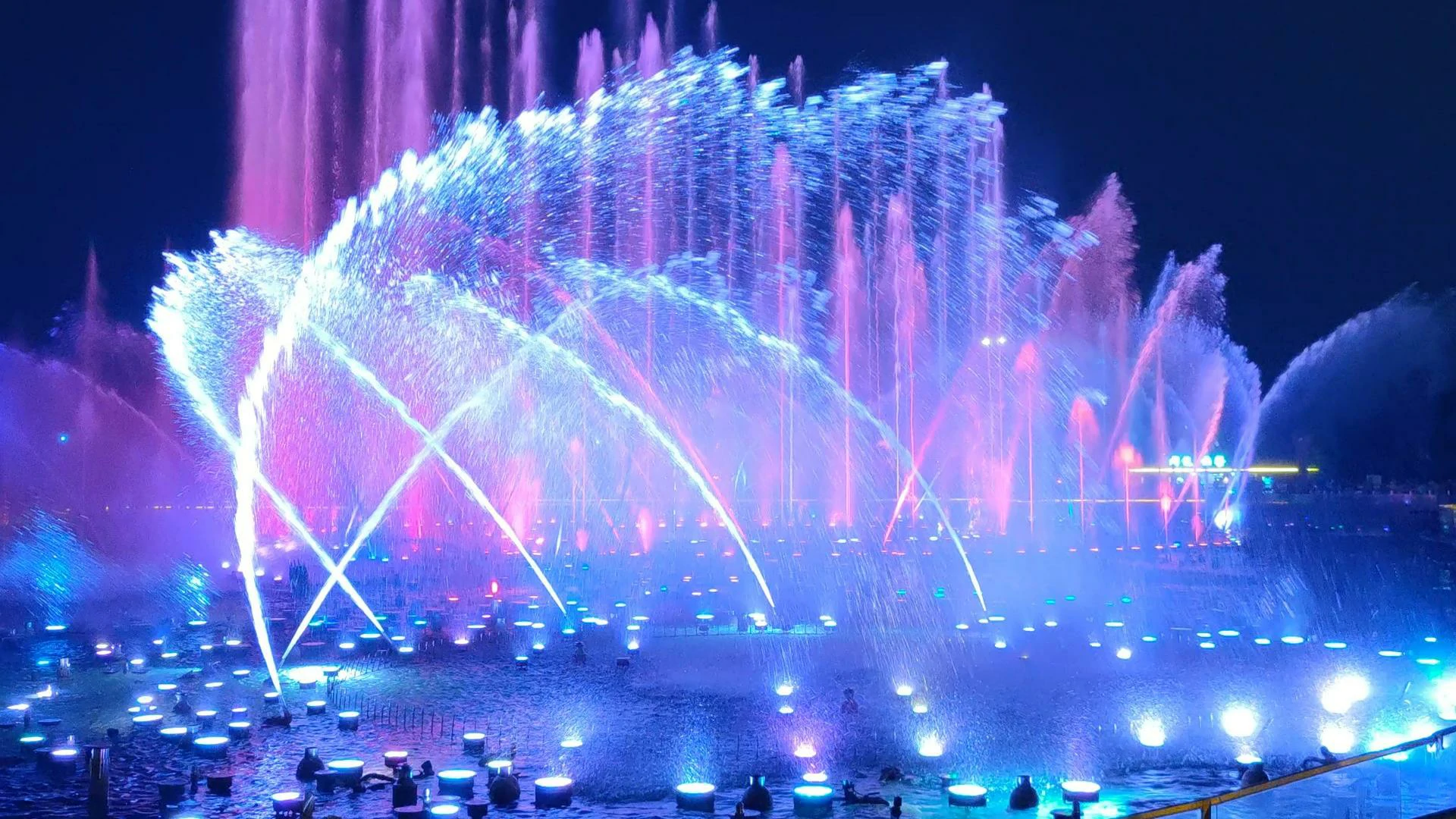
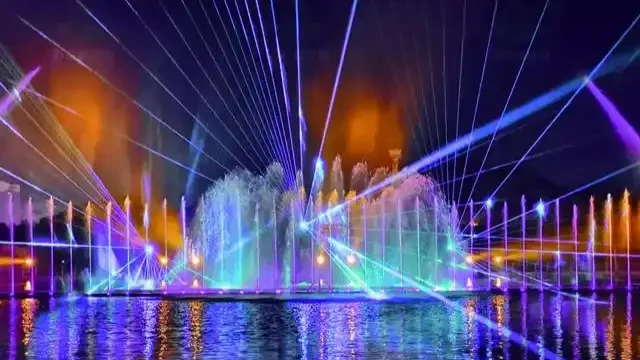
For demanding environments like the Dancing Fountain at Riyadh Season 2021’s Boulevard City, where shows run for hours every night, the reliability and color versatility of LED are indispensable.
3. Beam Angle: Spotlight vs. Floodlight
Selecting the right beam angle determines what you see and how you see it. This is where understanding the difference between a spotlight and a floodlight is critical.
Spotlights (Narrow Beam, typically <45°):
Purpose: To highlight a specific feature—a single tall jet, a sculpture, or a nozzle.
Effect: Creates drama, contrast, and focal points.
Application: Ideal for accent lighting on dancing fountain nozzles or the peak of a water column.
Floodlights (Wide Beam, typically >60°):
Purpose: To wash a large area with light.
Effect: Creates a soft, uniform glow.
Application: Perfect for illuminating the base of a fountain, a water curtain (like the Heze Laser Water Curtain, China), or a large reflecting pool.
Many modern fixtures offer interchangeable optics or adjustable beams, providing flexibility during the design and commissioning phases.
4. Understanding Light Decay (Lumen Depreciation)
All LEDs lose brightness over time. This is called light decay or luminous flux depreciation. A quality LED underwater light from a reputable fountain lights manufacturer will have a rated lifespan (e.g., L70) that indicates when it will reach 70% of its initial brightness.
Quality Matters: Poor-quality LEDs might suffer from rapid light decay within a year, leading to a dull, unevenly lit fountain.
Heat Management: Even though LEDs run cooler than halogen, they still generate heat. Proper thermal management (heat sinks, design) is vital to slow down light decay. Fixtures from an experienced fountain lights factory are engineered to dissipate heat effectively, even in submersed conditions.
5. Color Temperature and RGB Options
Static White: Measured in Kelvin (K). Lower numbers (2700K-3000K) are warm white, creating a cozy, romantic ambiance. Higher numbers (5000K-6500K) are cool white, appearing crisp and modern, often used in contemporary commercial plazas.
RGB (Red, Green, Blue): This is the industry standard for dynamic, color-changing fountains. By mixing these three colors, millions of hues can be created.
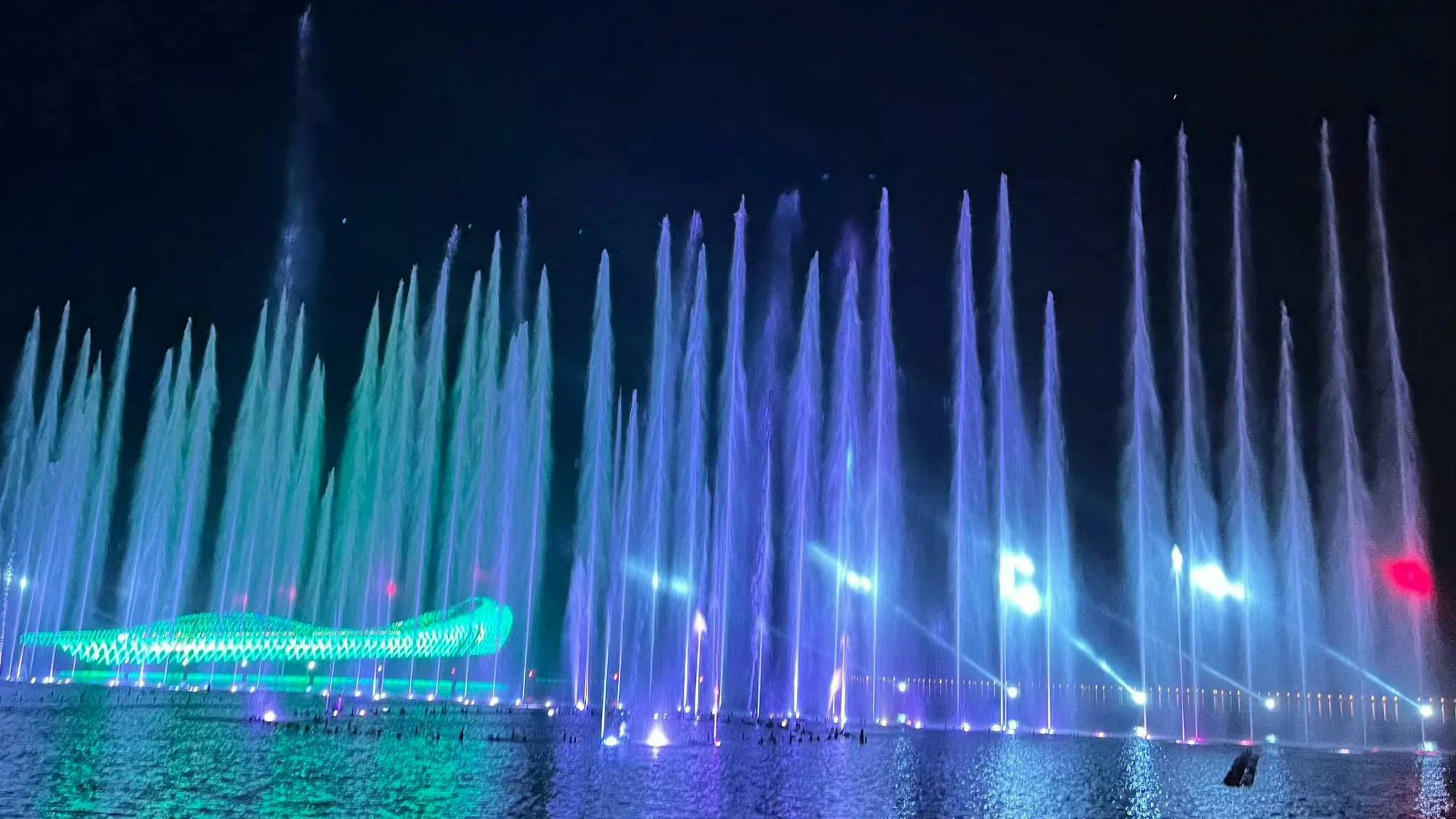
RGBW/WWA: Adding a dedicated White chip (RGBW) or Amber chip (RGBA) allows for richer pastel colors and more natural white light, which is essential for high-end shows like the Multimedia Water Show on Da Nhat Lake, Vietnam.
6. Material Selection: 304 vs. 316 Stainless Steel
The housing material must withstand constant water exposure and, in some cases, chemicals (like chlorine in pools).
304 Stainless Steel: The standard for most freshwater applications. It offers excellent corrosion resistance.
316 Stainless Steel: Contains molybdenum, offering superior resistance to chlorides and saltwater. This is the preferred choice for fountains using saltwater, installations near coastlines, or projects where maximum longevity is required.
Other Materials: High-quality engineering plastics (like PBT) are also common for smaller fixtures, offering excellent corrosion resistance at a lower cost.
7. Maintenance Considerations for Long-Term Value
A fountain is a long-term investment. Specify lights with features that simplify maintenance:
Modular Design: Can individual LEDs or drivers be replaced without replacing the entire fixture?
Cable Length & Connectors: Pre-attached, long cables with waterproof connectors simplify installation and replacement.
Driver Accessibility: For underwater fixtures, is the driver integral (simpler installation) or remote (easier maintenance access)? Both have their place depending on the project.
Conclusion
Selecting the right fountain lighting is a balance of art and science. By understanding IP ratings, beam angles, LED technology, and material quality, you can specify a system that delivers stunning visual impact and reliable performance for decades.
At HUALUO, all our fountain lights and underwater fixtures are designed and manufactured to meet the highest international standards, with rigorous testing for IP68 performance, light decay, and material durability. Whether your project requires precise optics for a dancing fountain in Saudi Arabia or robust fixtures for a floating fountain in the UK, we have the expertise and product range to bring your vision to light.
Ready to illuminate your next project? Contact our team for expert advice and detailed product specifications.
Related Posts

Get a Proposal & Budget Estimate
Send your site photos/video and basic data. We’ll reply with a platform concept direction, configuration suggestion, and budget estimate.
Contact Info.
- ADDRESS: No. 399, Antai Street, Economic Development Zone, Neijiang City, Sichuan Province, China.
- Email: sales@hualuolighting.com
- WHATSAPP: 0086 19302661002
Follow Us:
Your information is used only for project consultation.